
Stomp on Your Ego
A dying actor’s advice, cartoon and real-world villains, and a framework called HOPE

[Timeless Leadership is my blog about how everyday people build a positive, lasting legacy — when there's barely time to keep up with daily responsibilities. Thanks for reading.]
Read time: 9 minutes
What do a man recording his final words, a kids’ movie villain, and the Epstein files have in common?
They all reinforce that a sense of moral superiority, unchecked, is a pathway to evil.
Stomping on your ego is how you don't become evil yourself.
Building systems that make ego a liability, not an asset, is how we create a virtuous, Democratic Ownership Society that serves all people.
A Dying Man’s Advice
Eric Dane — best known as McSteamy on Grey’s Anatomy — died last week from ALS. The day after he passed, Netflix released his episode of Famous Last Words, an interview series recorded under the agreement that it only airs after the subject’s death.1
Dane was thoughtful and funny and remarkably at peace throughout. Despite noticeable physical impairments, his mind was sharp, his insights fully formed, and amidst many powerful reflections one line especially jumped out to me:
I would make a gentle suggestion…
every opportunity…
every SINGLE opportunity you have to stomp on your ego…
take it.”2
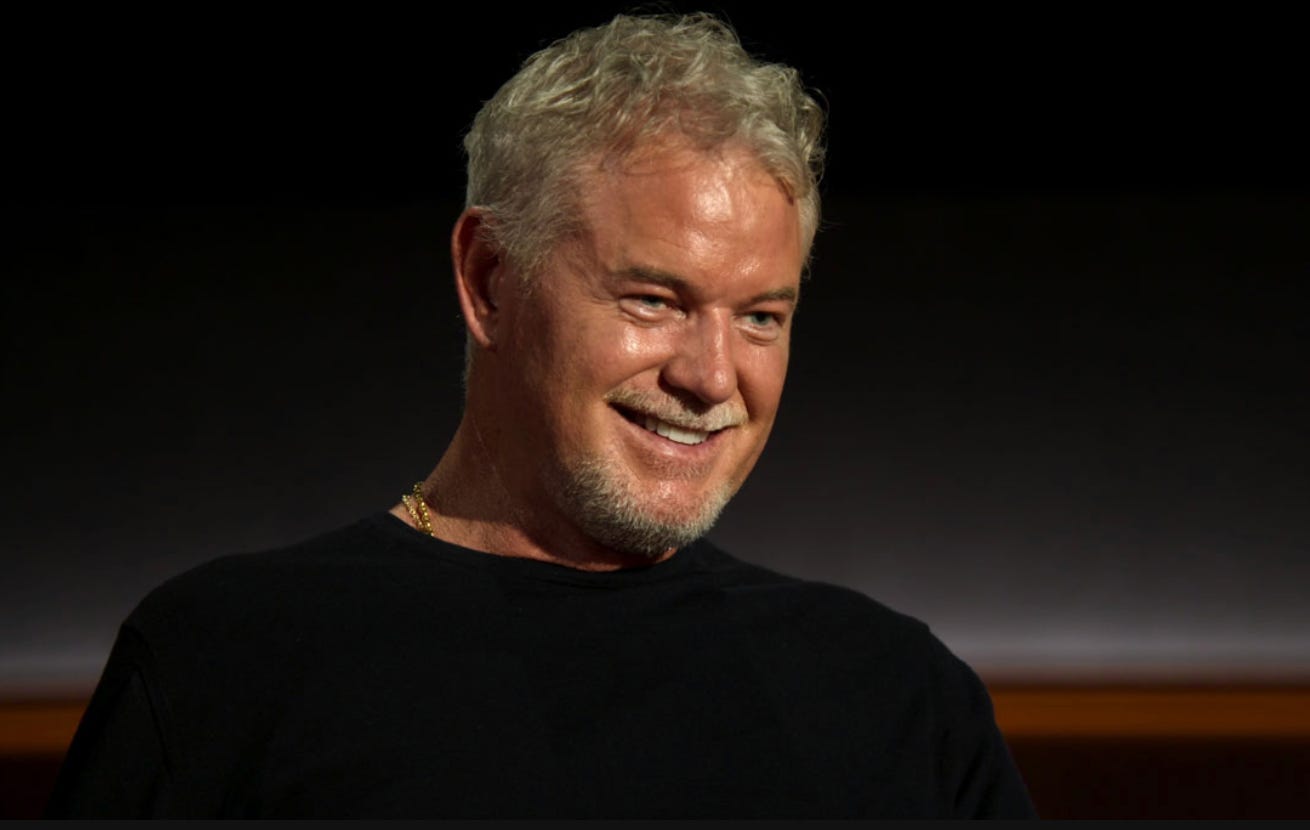
Dane knew his ego would disappear with his death. He got ready to part with it by stomping on it early. But he also talked about living on “in the memories of others” — in the people he’d loved, mentored, showed up for. He appears to blend these ideas to make peace with his losses and imminent departure.
It’s a lesson in short supply in the film I watched the very next day.
The Animated Bad Guys
A day after watching the Dane interview, I watched the 2022 DreamWorks movie Bad Guys with my kids.3
Fair warning: I’m about to extract a serious moral argument from a movie where a piranha can stink up an entire building with his noxious farts and a tarantula is a wizard computer hacker. Stay with me (also, spoilers ahead).
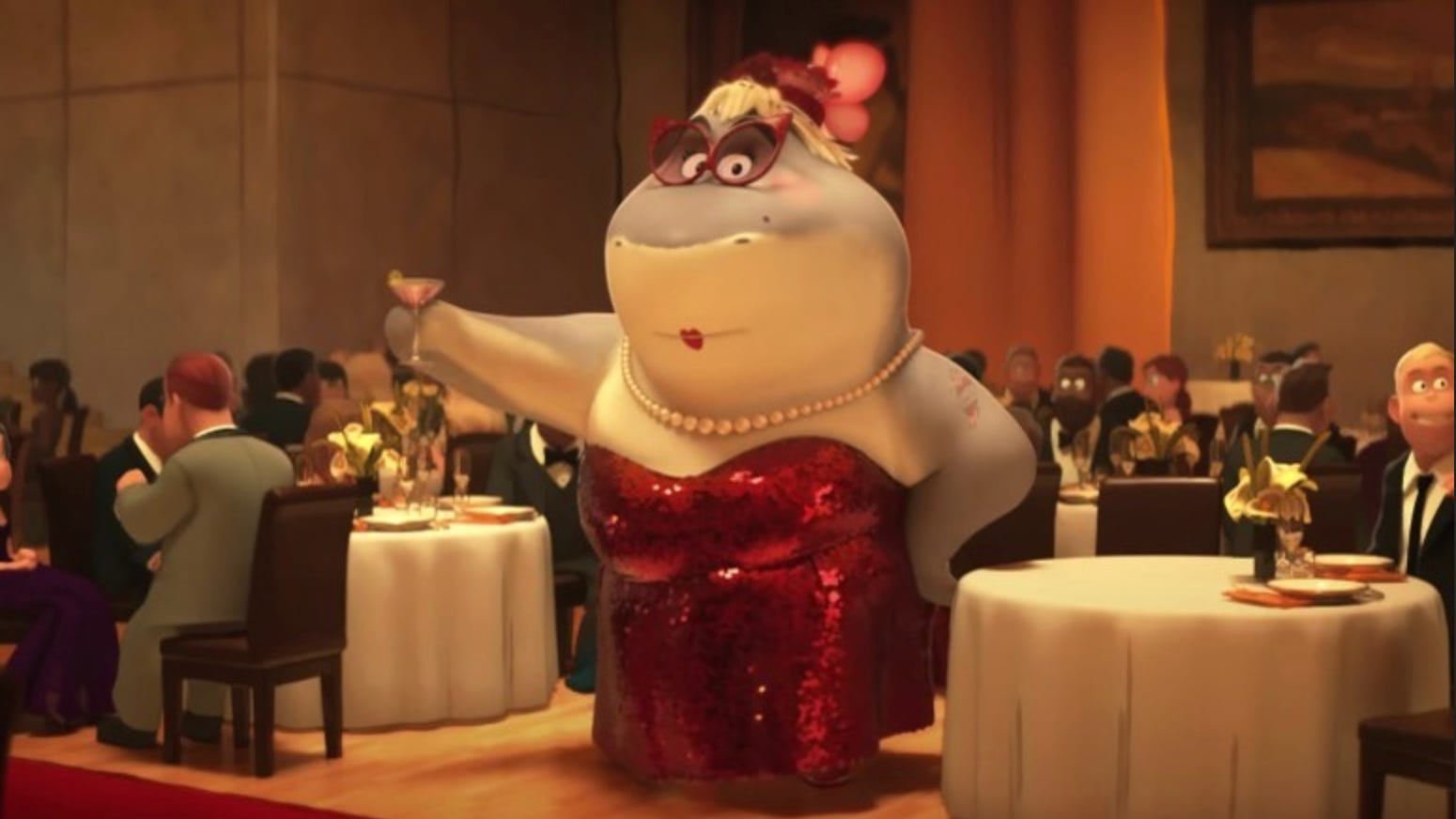
In Bad Guys, a crew of animal criminals get caught and are offered a shot at redemption under the mentorship of Professor Marmalade — an adorable guinea pig with a British accent who just won the film’s equivalent of the Nobel Peace Prize. If you’re already suspicious of the guinea pig, congratulations, you’re smarter than every character in the movie.
Eventually you find out that Marmalade is the true villain, and his outer image as humanity’s savior was just a ruse so he could steal from his charities and pin the theft on the traditional “bad guys” he had promised to reform.
The film’s writers offer a nugget of foreshadowing of this twist early on, when Marmalade compares himself favorably to Mother Teresa. Mother Teresa. If you know anything about her, this was the nun who spent her entire life serving the poor, sick, and destitute, not as a side-project or tax-write off, but for the work itself.
That’s the tell. While the main story arc was the transformation of the nominal bad guys from hardened criminals to our favorite anti-heroes, the less appreciated message of the movie is that elevated self-worth is one of the hardest flaws to overcome. It can even give rise to true evil.

I love that a DreamWorks comedy can teach complex lessons about good and evil — if you're paying attention. A whole industry of children’s media tries to do the hard work of setting up future generations (and their parents) to understand these things.
Unfortunately, these lessons don’t reach everyone, and even the craziest fictional plots hardly capture the depravity of what some people do in real life.
The Real Bad Guys
Millions of Epstein files have become public since the start of the year, and the scandal is so damning it’s tempting to tune it out entirely. If even Noam Chomsky4 had a relationship with this guy, if countless institutions, from Ivy League schools to JP Morgan somehow maintained contact with him, could he have been so bad? And if so, and the rot is so deep, what can one average person even do with this information?
Yes, it’s critical to pay attention, but not to memorize every detail.
We have to understand the dynamics that gave rise to this nefarious network, so we can call for accountability for the individual actors AND prevent such evil from repeating in the future.
Epstein could traffic, rape, and torture for so long and at such a large scale because functionally, he was a power broker. He connected influential people. He moved money around. And as part of his system of manipulation he lured those seeking more power into his system of abuse, trapping them in a conspiracy of silence and complicity.
We don’t live in a DreamWorks movie where a clean victory is guaranteed in 90 minutes. While shimmers of accountability are shining through in parts of Europe, the same people and practices that allowed this criminal abomination to fester are now infecting the core apparatus of truth and justice.
We need a reckoning, and we need to prevent such crimes from ever happening again.
There’s no hope in the files themselves. Only in what we choose to build in response — the structures, the accountability, the alternative. That’s where HOPE comes in.
So What Do We Build?
I’ve talked for a long time about the vision for Timeless Leadership: we’re trying to build a Democratic Ownership Society. What does that society look like? What are the specific changes to work toward?
I brought these questions into February’s Basecamp discussion — not as an open-ended prompt, but as a proposal.
HOPE is a framework for identifying what we need to change in our relationship with the earth, with our systems, with each other, and with ourselves — to build a society we’d want to live in and be proud to pass on.
Here’s how it works.
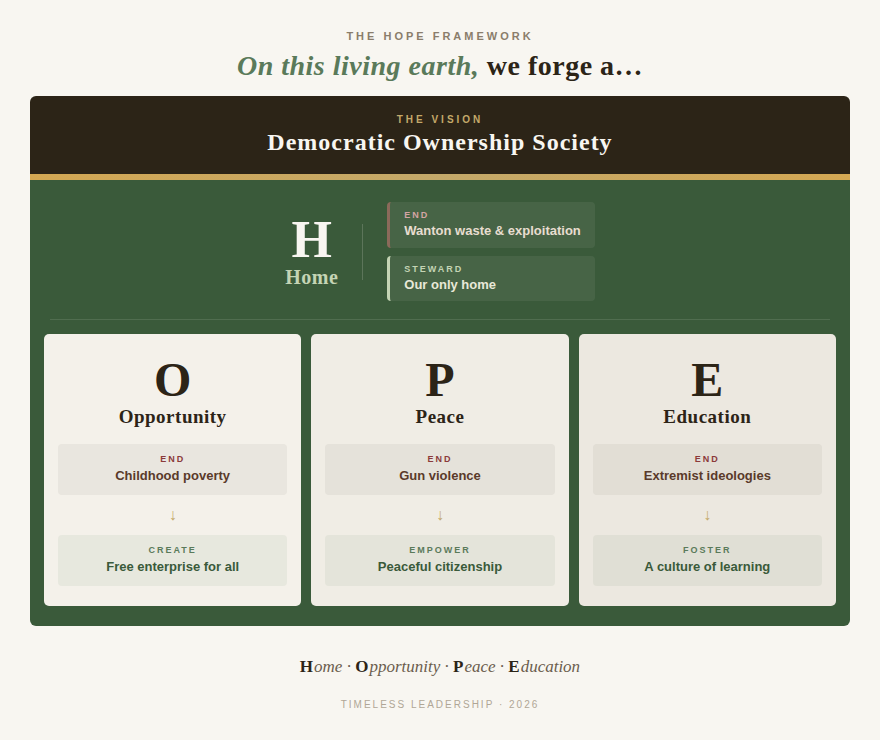
The opening line grounds us:
On this living earth, we forge a Democratic Ownership Society…
This isn’t a metaphor. It’s a scope statement. Everything that follows happens here — on this planet, among all living things. Not on a distant planet or drifting space craft.
Here.
We then develop the foundational layer that determines everything else: our Home. Earth. Unless we end wanton waste and exploitation, and replace it with stewardship of our only home, we’re screwed.5 Nothing else really matters.
Once you’re grounded, we have three pillars, with concrete, measurable changes to strive for:
Opportunity — End childhood poverty. Create free enterprise for all.
Peace — End gun violence. Empower peaceful citizenship.
Education — End extremist ideologies. Foster a culture of learning.
There’s a lot of shit out there to keep us depressed, distracted, and apathetic. What gets us off our asses is being able to focus on unambiguous things we want to end, and the concrete replacement we’re building to replace them.
This is not a utopian vision or a pipe-dream. It’s a specific program for how to direct our work and resources to build a positive, lasting shared legacy.
But building that legacy starts with honesty. There are no "good guys." Just people who do good things, and sometimes screw up.
I've been striving to do good things for a long time, and I haven't always succeeded.
Maybe you feel that way too.
What matters is that we learn from it, strive to do better, and never believe we're better than anyone else — lest we prove the polar opposite.

HOPE can help with portfolio planning, it can help with life design, it can help with organizational and movement strategy.
It can help us separate from our egos, and worry less about who’s a good vs bad guy. It can help us focus on whether we’re building the systems that promote more of the good, and less of the bad.
In future posts I’ll share more about why I chose these specific pillars, how they interact, why certain things are left out, and what to do with all of it.
In the meantime I hope (😉) you’ll share:
What’s one way we can build systems for good that not a lot of people think about?
Leave a comment (references to cartoons and Netflix documentaries welcome!)
PS. A Note about Basecamp
In April Basecamp turns one year old! Next week we hold our 12th monthly session. That means it’s nearly a full year of showing up, going deep, and building the practice of Timeless Leadership together.
If you’ve been reading along and thinking I want to be in that (Zoom) room — now is a good time to join. It’s still just $97/year for monthly group conversations that regularly go places I never planned for them to go, but we’re all richer for it.
All you need to do is upgrade with the button below and you’ll be added to the call invite (first Thursday of every month at 9:30am Pacific).
Hope to see you there!
-Joe “Stomping on my ego” Ballou
Famous Last Words is really worth watching. The format — just one person and an interviewer, no editing — creates something remarkably honest. I actually mentioned this series back in October when the first episode came out — the Jane Goodall interview, released after she passed at 90. There are just these two episodes now, so it’s not so hard to get caught up (this hopefully will not be a series with frequent new episodes, given the premise).
Ryan Holiday wrote an entire book on this — Ego is the Enemy. Dane said it in 12 words.
My son is 4 and my daughter is 7. The movie has a surprisingly strong message buried under the fart jokes. As kids’ movies go, you could do a lot worse.
Shout out to Basecamp member Mike who recommended adding an “against” statement to the Home layer. The original proposal lacked that.
…love this but having worked at dreamworks, and the epstein adjacent tales of what katzenberg was doing with teenagers in the hollywood hills, i must fart that we are barely scratching the surface of what power and opportunity do for the depravity capacity of humans (reminder all presidents are justified murderers)…that dane share is epic bud, so sad we mainly get heard on our way out the exits…
Smashing one's ego is a powerful message and a hard practice to undertake. Setting ego aside is hard enough for many.
I like where you're going with HOPE and appreciate the addition of the pro/con on Home